Neurofascial Transformation Process™ — From Encoded Experience to Embodied Integration

Foundational Essay
A Relational, Phase-Based Pathway for Trauma Repair, Embodiment, and Personal Evolution
“Trauma victims cannot recover until they become familiar with and befriend the sensations in their bodies.” — Bessel van der Kolk
By Dirk Marivoet, MSc
Founder of Core Strokes® & The Neurofascial Transformation Process™
International Institute for Bodymind Integration
Orientation — What Is the Neurofascial Transformation Process™?
The Neurofascial Transformation Process™ (NTP) is a relational, phase-based framework describing how the bodymind reorganizes lived experience over time.
It is not a technique, protocol, or rapid reset method.
It is a process of embodied reorganization that unfolds through breath, fascia, nervous system regulation, relational presence, and time.
Developed by Dirk Marivoet within the Core Strokes® framework, the Neurofascial Transformation Process™ offers a map for how trauma, developmental interruption, and relational wounding can transform — not through force or catharsis, but through attuned contact, co-regulation, and precise sequencing.
Where Neurofascial Encoding™ describes how experience becomes written into tissue, the Neurofascial Transformation Process™ describes how that writing can soften, reorganize, and integrate, restoring coherence, presence, and participation in life.
From Encoding to Transformation
Human experience does not live only in memory or narrative.
It is encoded across breath patterns, fascial tone and texture, posture, autonomic regulation, and relational expectation.
Within Core Strokes®, this embodied organization is described as Neurofascial Encoding™.
When experience overwhelms the organism — whether through shock trauma, chronic stress, early developmental conditions, or relational rupture — the body adapts:
breath becomes held, fragmented, or biased
fascia densifies, braces, collapses, or fragments
autonomic regulation fixes into hyperarousal or shutdown
relational contact becomes unsafe or effortful
These adaptations are not pathological.
They are intelligent survival responses.
The Neurofascial Transformation Process™ begins when these responses are met rather than overridden, and when the body is supported to reorganize at its own pace.
From Neurofascial Encoding™ to Neurofascial Transformation
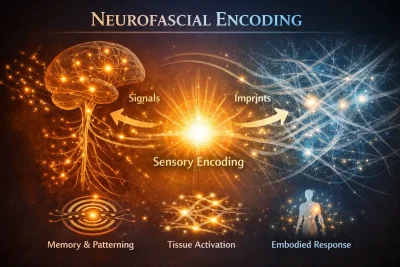
Illustration of Neurofascial Encoding™, showing how sensory signals, fascial imprints, and embodied responses interact to shape memory and tissue patterning within the Core Strokes® framework.
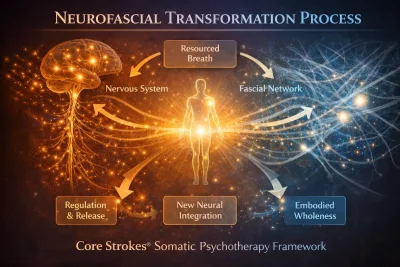
Illustration of the Neurofascial Transformation Process™ in Core Strokes®, showing how breath regulation, nervous system dynamics, and fascial reorganization support embodied transformation.
Why Transformation Must Be Relational
The body does not reorganize in isolation.
Trauma and developmental interruption occur in relationship, and they are repaired through relationship — not only through insight or release.
The Neurofascial Transformation Process™ is grounded in co-regulation, including:
the practitioner’s regulated presence
attuned, non-intrusive contact
breath-based pacing and tracking
sensitivity to boundaries, readiness, and consent
Rather than doing something to the body, the practitioner listens into the tissue and supports its inherent intelligence to reorganize.
Transformation unfolds when the system feels:
safe enough to sense
supported enough to soften
accompanied enough to change
The Role of Breath — The Energetic Breath Cycle™
Breath is the primary organizer of transformation.
Within Core Strokes®, the Energetic Breath Cycle™ describes a natural spiral of pulsation through distinct phases of safety, receptivity, exploration, freedom, excitation, integration, surrender, and rest.
Trauma disrupts this cycle.
The Neurofascial Transformation Process™ works by restoring breath rhythm and phase coherence, allowing pulsation to return where it was interrupted.
As breath reorganizes:
fascia rehydrates and softens
autonomic flexibility increases
emotional flow resumes
relational presence deepens
This work builds upon the Natural Energetic Cycle developed by Jack W. Painter, PhD, refining and extending it through contemporary fascia science, attachment theory, and polyvagal understanding.
The Five Phases of the Neurofascial Transformation Process™
The Neurofascial Transformation Process™ unfolds through five interrelated phases.
These phases are not linear steps, but a spiral that may repeat, deepen, or pause as needed.
1️⃣ Attunement and Orientation
Establishing safety, presence, and co-regulation.
orienting to breath, sensation, and contact
reading fascial tone and autonomic state
building the relational field as a secure container
Without this phase, transformation cannot proceed.
2️⃣ Contact and Co-Regulation
Meeting the body in relationship.
verbal and non-verbal contact
touch (when appropriate and consented)
supporting tolerance for sensation and micro-change
stabilizing autonomic shifts
Here, the body begins to feel met rather than managed.
3️⃣ Activation and Unwinding
Releasing held patterns safely.
gentle activation of encoded patterns
fascial unwinding, tremor, movement, breath shifts
discharge without overwhelm
restoration of pulsation
This phase is guided, paced, and relational — never forced.
4️⃣ Reorganization and Patterning
Integrating new possibilities.
reorganizing breath, posture, and movement
supporting new relational experiences
stabilizing autonomic regulation
allowing meaning and coherence to emerge
The body learns new ways of being.
5️⃣ Integration and Resonance
Embodiment and continuity.
grounding change into daily life
supporting ownership of transformation
establishing templates for future regulation and growth
opening space for spiritual presence and meaning
Transformation becomes lived, not just experienced.
What Happens in a Session?
A Neurofascial Transformation Process™ session may include:
breath-based regulation
fascial work through touch, movement, or awareness
tracking of Neurofascial Encoding™
micro-movement and spontaneous reorganization
relational presence and dialogue
integration and reflection
Each session is responsive, not scripted.
What Clients Often Experience
Over time, clients may report:
relief from chronic symptoms
increased breath capacity
greater emotional resilience
improved sleep and vitality
restored trust in the body
deeper relational presence
reconnection with meaning, joy, and spiritual depth
Change is often gradual, cumulative, and stable.
How NTP Complements Other Approaches
Compared to talk therapy
→ NTP works directly with embodied and pre-verbal layers.Compared to manual therapy
→ NTP integrates emotional, relational, and meaning-making dimensions.Compared to trauma techniques
→ NTP offers a whole-system, phase-based, relational pathway.
It complements psychotherapy, somatic therapies, movement practices, meditation, and spiritual inquiry.
Who Is the Neurofascial Transformation Process™ For?
NTP™ supports people working with:
trauma and PTSD
developmental and attachment trauma
anxiety, depression, and chronic stress
psychosomatic symptoms
sexual trauma and relational wounding
personality adaptations
personal growth and embodiment
embodied spirituality and integration
It is also a practice path for practitioners, not only for clients.
A Path of Embodied Integration
Healing is not about erasing the past.
It is about transforming how the past lives in the body.
Through the Neurofascial Transformation Process™, people can:
restore flow
reclaim breath
soften defensive holding
rebuild trust and presence
re-enter life with greater coherence
This is a path
through the body
for the whole being
in relationship
in service of life itself
Lineage and Ongoing Work
The Neurofascial Transformation Process™ was developed by Dirk Marivoet, founder of Core Strokes® and the International Institute for Bodymind Integration, in dialogue with the lineage of Wilhelm Reich, Jack W. Painter, Al Pesso, and contemporary neuroscience, attachment research, and fascia science.
This work is offered internationally through individual sessions, workshops, and professional trainings, and continues to evolve through clinical practice, teaching, and research.
Read also:
Selected References
Davis, W. (2020). Funktionale Analyse – Grundlagen und Anwendungen in der Körperpsychotherapie. Gießen: Psychosozial-Verlag.
Keleman, S. (1985). Emotional Anatomy: The Structure of Experience. Center Press.
Levine, P. A. (2010). In an Unspoken Voice: How the Body Releases Trauma and Restores Goodness. North Atlantic Books.
Marivoet, D. (2025). The Living Language of Fascia — A Clinical Typology of Tissue States in Somatic Psychotherapy. Somatic Psychotherapy Today, 15(1), 24-33.
Marivoet, D. (2025). The Energetic Breath Cycle™: Phenomenological Layers of Respiratory Experience. Somatic Psychotherapy Today, 15 (1), 58-73.
Marivoet, D. (2025). The Poetics of Unnamed Emotion: From The Dictionary of Obscure Sorrows to Core Strokes®. https://somaticpsychotherapytoday.com/the-poetics-of-unnamed-emotion-from-the-dictionary-of-obscure-sorrows-to-core-strokes/
Marivoet, D. (2026). Neurofascial Encoding™: A somatic framework for trauma repair through breath, movement, and touch. Manuscript submitted for peer review, International Body Psychotherapy Journal.
Painter, J. (1987). Deep Bodywork and Personal Development: Harmonizing Body, Emotions and Thoughts. Bodymind Books.
Pesso, A. (n.d.). Presentations & lectures by Albert Pesso on Pesso Boyden System Psychomotor Therapy (1984–2012). Kindle edition.
Porges, S. W. (2011). The Polyvagal Theory: Neurophysiological Foundations of Emotions, Attachment, Communication, and Self-regulation. W. W. Norton & Company.
Schleip, R., Findley, T. W., Chaitow, L., & Huijing, P. A. (Eds.). (2012). Fascia: The Tensional Network of the Human Body – The Science and Clinical Applications in Manual and Movement Therapy. Elsevier.
Selvam, R. (2022). The Practice of Embodying Emotions: A Guide for Improving Cognitive, Emotional, and Behavioral Outcomes. North Atlantic Books.
Stecco, C. (2015). Functional Atlas of the Human Fascial System (2nd ed.). Churchill Livingstone.
van der Kolk, B. A. (2014). The Body Keeps the Score: Brain, Mind, and Body in the Healing of Trauma. Viking.