
Neurofascial Encoding™ − How Experience is Written into Tissue

Foundational Essay
By Dirk Marivoet, MSc
Founder of Core Strokes® & The Neurofascial Transformation Process™
International Institute for Bodymind Integration
This article builds on the framework presented in:
Marivoet, D. (2026). Neurofascial Encoding™: A Somatic Framework for Trauma Repair through Breath, Movement, and Touch. (Manuscript submitted for peer review).
A Foundational Orientation
Neurofascial Encoding™ is not a concept to be understood in a single reading.
It is an embodied framework that reveals itself through observation, touch, and relational presence.
It unfolds as we listen to breath, feel tissue responsiveness, observe posture and movement, and sense the relational field between bodies. Through these channels, the body shows us not only what it has lived — but how it has learned to live.
Neurofascial Encoding™ describes how lived experience — emotional, developmental, relational, and traumatic — becomes organized across fascia, breath, nervous system regulation, posture, and expectation of contact.
Experience is not primarily stored as narrative memory.
It is encoded as patterns of tissue tone, texture, hydration, elasticity, and responsiveness, shaping perception, behavior, autonomic regulation, and relational style long before words are available.
Neurofascial Encoding™ is not a technique and not a treatment method.
It is a descriptive and relational model for understanding how experience becomes embodied, organized, and transmitted over time — and how it becomes accessible again through breath, touch, and co-regulated presence.
The term Neurofascial Encoding™ was introduced within the Core Strokes® framework at the International Institute for Bodymind Integration to articulate forms of embodied memory that extend beyond cognitive, behavioral, or purely neurological models.
These processes are situated within the broader field of somatic psychotherapy, where the body is understood as a primary medium of experience and transformation.
→ Somatic psychotherapy
Touching What the Body Remembers
Every moment we live leaves a trace — not only in the mind, but in the tissues of the body.
Within the Core Strokes® framework, Neurofascial Encoding™ refers to how emotional experience, early developmental conditions, attachment patterns, and trauma become biologically and relationally organized within the connective tissue matrix of the body.
These are not narrative memories.
They are somatic memories — written through breath rhythm, muscular tone, fascial density, posture, gesture, and the capacity (or difficulty) to meet contact.
Fascia — the body’s continuous connective tissue network — does not merely support structure or transmit force. It functions as a living, sensing matrix, deeply responsive to emotional state, relational safety, and autonomic tone.
Through its texture, hydration, elasticity, and responsiveness, fascia retains the imprint of experience:
the tenderness of safe contact
the shock of rupture
the contraction of fear
the vigilance of defense
the yielding of trust
Unlike the nervous system alone, fascia records experience in a way that is simultaneously structural, emotional, energetic, and relational. It remembers how the body adapted — not just what happened.
In this way, emotion becomes structure, and structure becomes expectation.
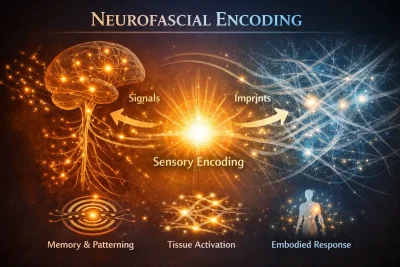
Illustration of Neurofascial Encoding™, showing how sensory signals, fascial imprints, and embodied responses interact to shape memory and tissue patterning within the Core Strokes® framework.
Neurofascial Encoding™ as a Clinical Lens
Neurofascial Encoding™ weaves together:
contemporary fascia science
somatic and developmental psychology
trauma and attachment theory
Reichian and post-Reichian character theory
breath-based and relational regulation
energetic and phenomenological presence
It offers clinicians a way to read the body as a living archive, where defensive adaptations, unmet needs, and survival strategies are not judged or pathologized, but understood as intelligent responses to lived conditions.
This lens allows us to perceive:
how breath phases were interrupted or shaped
how autonomic regulation became fixed or fragmented
how relational safety was compromised or restored
how character patterns crystallized in tissue
how the body learned to hold, brace, collapse, split, or overextend
And crucially: it shows us where change is still possible.
The Neurofascial Transformation Process™
From Encoding to Reorganization
If Neurofascial Encoding™ describes how experience becomes embodied, the Neurofascial Transformation Process™ (NTP) describes how that embodiment can change.
Transformation is not mechanical.
It is relational, rhythmic, and phased.
The body does not simply “release” what it holds.
It reorganizes when it feels seen, met, and safely accompanied.
In the Neurofascial Transformation Process™, transformation unfolds through:
attuned touch and presence
breath-based co-regulation
careful sequencing rather than catharsis
respect for protective adaptations
moment-to-moment tracking of tissue response
The practitioner does not impose change.
They listen into the tissue and support its inherent intelligence to unwind, reorganize, and re-pattern.
This includes working with:
fascial textures that reflect emotional and developmental adaptation
(e.g. gritty, sticky, collapsed, dense, fibrotic, streaming)
breath–character patterns embedded in posture and movement
pulsation rhythms shaped by interruption, shock, or chronic defense
co-regulation and resonance as gateways to reorganization
At the heart of Core Strokes®, the Neurofascial Transformation Process™ offers a somatic cartography for moving:
from fragmentation to coherence
from contraction to contact
from armoring to presence
from survival to participation
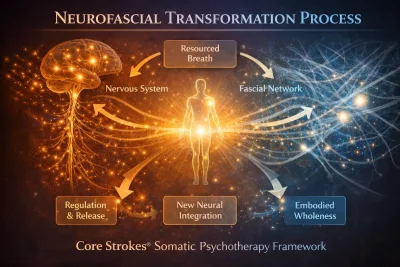
Illustration of the Neurofascial Transformation Process™ in Core Strokes®, showing how breath regulation, nervous system dynamics, and fascial reorganization support embodied transformation.
Why This Work Matters
In a world that often tries to heal trauma through language alone, Neurofascial Encoding™ reminds us that the body remembers first.
Tissue tells us where the story paused.
Fascia shows us where pulsation stopped.
Breath reveals where safety was lost or withheld.
And the body does not only want to survive its story.
It wants to complete it, integrate it, and move beyond it.
When we learn to read and respond to the language of fascia, we open the possibility of becoming more whole — not only mentally coherent, but:
viscerally alive
emotionally fluid
energetically available
relationally grounded
This is the promise of the Neurofascial Transformation Process™:
Not to erase the past,
but to embody it differently —
with new rhythm, new shape, and renewed meaning.
Ongoing Work
These concepts are part of a larger integrative vision developed across my clinical practice, trainings, and forthcoming book, where I explore in depth:
the mechanisms of Neurofascial Encoding™
the five phases of the Neurofascial Transformation Process™
the Window of Transformation — the somatic-relational space where stored experience becomes available for re-patterning, integration, and meaning-making
Read also:
Selected References
Davis, W. (2020). Funktionale Analyse – Grundlagen und Anwendungen in der Körperpsychotherapie. Gießen: Psychosozial-Verlag.
Keleman, S. (1985). Emotional Anatomy: The Structure of Experience. Center Press.
Levine, P. A. (2010). In an Unspoken Voice: How the Body Releases Trauma and Restores Goodness. North Atlantic Books.
Marivoet, D. (2025). The Living Language of Fascia — A Clinical Typology of Tissue States in Somatic Psychotherapy. Somatic Psychotherapy Today, 15(1), 24-33.
Marivoet, D. (2025). The Energetic Breath Cycle™: Phenomenological Layers of Respiratory Experience. Somatic Psychotherapy Today, 15 (1), 58-73.
Marivoet, D. (2025). The Poetics of Unnamed Emotion: From The Dictionary of Obscure Sorrows to Core Strokes®. https://somaticpsychotherapytoday.com/the-poetics-of-unnamed-emotion-from-the-dictionary-of-obscure-sorrows-to-core-strokes/
Marivoet, D. (2026). Neurofascial Encoding™: A somatic framework for trauma repair through breath, movement, and touch. Manuscript submitted for peer review, International Body Psychotherapy Journal.
Painter, J. (1987). Deep Bodywork and Personal Development: Harmonizing Body, Emotions and Thoughts. Bodymind Books.
Porges, S. W. (2011). The Polyvagal Theory: Neurophysiological Foundations of Emotions, Attachment, Communication, and Self-regulation. W. W. Norton & Company.
Schleip, R., Findley, T. W., Chaitow, L., & Huijing, P. A. (Eds.). (2012). Fascia: The Tensional Network of the Human Body – The Science and Clinical Applications in Manual and Movement Therapy. Elsevier.
Selvam, R. (2022). The Practice of Embodying Emotions: A Guide for Improving Cognitive, Emotional, and Behavioral Outcomes. North Atlantic Books.
Stecco, C. (2015). Functional Atlas of the Human Fascial System (2nd ed.). Churchill Livingstone.
van der Kolk, B. A. (2014). The Body Keeps the Score: Brain, Mind, and Body in the Healing of Trauma. Viking.