
Soul Textures in Somatic Psychotherapy

Foundational Essay
A Phenomenological Framework within Bodymind Integration
By Dirk Marivoet, MSc
Body-oriënted psychotherapist · Founder of Core Strokes®
International Institute for Bodymind Integration
Introduction — Why a New Term Is Needed
In body-oriented and somatic psychotherapy, clinicians work at the intersection of lived experience, physiological organization, and relational presence. Over the decades, a rich vocabulary has developed to describe this terrain: affect, emotion, arousal, character, defense, state, structure, attachment pattern. Each of these concepts has advanced clinical understanding, yet each also reveals a limitation when therapists attempt to describe how experience actually appears in the living body.
What is often missing is a language for qualitative embodiment — for the felt, observable, relationally expressed ways in which psychological and existential organization take form through breath, fascia, posture, tone, and contact. It is in response to this gap that the concept of Soul Textures has emerged within contemporary bodymind integration.
The term does not name a belief, a metaphor, or a spiritual abstraction. It names a phenomenological reality encountered daily in somatic clinical practice.
Within this context, Soul Textures can be understood as differentiated expressions of soul resonance—the felt experience of coherence as it becomes perceptible in the living body.
→ Read: What Is Soul Resonance
Definition — What Are Soul Textures?
Within Bodymind Integration and somatic psychotherapy, Soul Textures refer to recurrent qualitative patterns through which the soul organizes itself in embodied life. They are expressed simultaneously through breath, fascial responsiveness, postural tone, affective coloration, movement quality, and relational presence.
In this clinical and phenomenological context, Soul Textures are:
Embodied — they appear in tissue, breath, and posture
Relational — they shape how contact is given and received
Developmental — they emerge through lived history
Phenomenological — they are perceived through direct observation and felt sense
Within this therapeutic framework, Soul Textures are not:
artistic or decorative textures
lifestyle or branding concepts
digital, visual, or material design elements
symbolic metaphors detached from bodily process
In Bodymind Integration, Soul Textures function as clinical descriptors within body-oriented psychotherapy, offering a precise language for how psychological life takes shape in the living organism.
Soul Textures are understood within the broader field of somatic psychotherapy…
→ Somatic psychotherapy overview
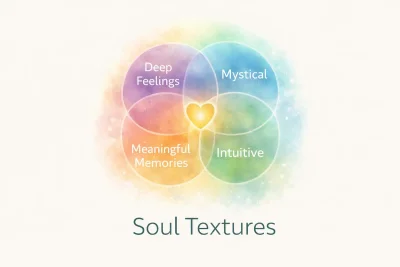
Soul Textures™ describe qualitative layers of embodied experience through which emotional depth, intuitive knowing, meaning, and spiritual awareness become expressed in the living body.
Phenomenological Ground — What Is Observed?
Soul Textures are not inferred primarily from narrative content or cognitive meaning. They are perceived through direct phenomenological observation, including:
density or lightness in tissue
fluidity or resistance in fascial layers
continuity or fragmentation of breath
tone of muscular holding or yielding
timing, rhythm, and amplitude of movement
transparency or opacity in relational presence
These qualities are not random. They form coherent patterns that repeat across situations and relationships, revealing how the organism has learned to inhabit itself.
The language of texture is used deliberately. Texture describes how something is, not what it represents. It allows clinicians to remain close to lived experience without prematurely translating it into psychological interpretation.
Soul, Body, and Phenomenology
The word soul is used here in a phenomenological, rather than metaphysical, sense. It refers to the organizing principle of subjective life — the animating coherence through which sensation, meaning, vitality, and relationship converge.
In somatic psychotherapy, the soul is encountered not as an abstract entity, but as a pattern of presence:
how a person inhabits gravity
how aliveness circulates or withdraws
how contact is met or avoided
how inner and outer worlds are bridged
Soul Textures name these patterns as they are lived and perceived in the body.
Relationship to Fascia and Breath
Within bodymind integration, Soul Textures are inseparable from fascial organization and breath dynamics.
Fascia provides the connective medium through which force, sensation, and meaning are distributed. Breath provides the rhythmic modulation through which the organism expands, contracts, pauses, and integrates.
Together, breath and fascia form a living matrix in which Soul Textures become visible:
certain textures appear as dense, absorptive, or weighted
others as elastic, oscillating, or streaming
others as brittle, fragmented, or collapsed
These qualities are not merely physiological. They carry psychological history, relational adaptation, and developmental imprinting.
Clinical Function — Why Soul Textures Matter
Soul Textures offer clinicians a way to orient without reducing the client to diagnosis or pathology. They support:
attuned assessment without premature interpretation
relational pacing and contact regulation
developmental understanding beyond narrative memory
trauma-informed work grounded in present-moment embodiment
By tracking texture rather than symptom alone, therapists can accompany transformation as it unfolds — from rigidity toward fluidity, from fragmentation toward coherence, from collapse toward presence
Positioning Within the Field
Soul Textures belong within the domain of:
body-oriented psychotherapy
somatic and developmental psychology
phenomenological clinical practice
trauma-informed relational work
They are distinct from artistic, lifestyle, or spiritual branding uses of the term “texture.” Their meaning arises exclusively from clinical observation and embodied interaction.
Relation to the Core Strokes® Framework
Within the Core Strokes® framework, Soul Textures are further articulated through systematic mapping of breath phases, fascial textures, developmental dynamics, and relational patterns. Core Strokes® provides a structured methodology for working with these textures in therapeutic, educational, and training contexts.
The present essay offers the conceptual foundation. The applied clinical elaboration belongs to that framework.
Conclusion
Soul Textures provide a language for what has long been sensed but insufficiently named in somatic psychotherapy: the qualitative ways in which soul and body co-organize lived experience. By remaining close to phenomenology, they allow clinicians to work with depth, precision, and relational integrity — without collapsing embodiment into metaphor or technique.
They are not added on to therapy.
They are already there, waiting to be perceived.
Read also: