The Energetic Breath Cycle™ — A Developmental Framework for Somatic Psychotherapy

Foundational Essay
By Dirk Marivoet, MSc
Founder of Core Strokes® & The Neurofascial Transformation Process™
International Institute for Bodymind Integration
Marivoet, D. (2025), The Energetic Breath Cycle™ : Phenomenological Layers of Respiratory Experience. Somatic Psychotherapy Today, 15(1), 58-73.
At a Glance
The Energetic Breath Cycle™ is a nine-phase developmental and phenomenological model describing how breath, fascia, energy, nervous system, and relational dynamics organize across life and moment-to-moment experience. It is used in somatic psychotherapy for assessment, trauma resolution, character integration, and embodied transformation.
It serves as both a clinical map and a pathway of embodied development.
“Every breath is a wave of life. Every wave carries memory, potential, and the possibility of transformation.”
— Dirk Marivoet
Canonical Orientation
The Energetic Breath Cycle™ is not a breathing technique, exercise system, or regulation method.
It is a developmental and phenomenological model describing how breath, energy, fascia, and consciousness organize through distinct phases across the lifespan and in real-time experience.
While many breathwork approaches focus on consciously manipulating breathing to regulate states, the Energetic Breath Cycle™ tracks how breathing organizes itself — revealing where flow is supported, interrupted, distorted, or restored within the organism.
The Energetic Breath Cycle™ emerges from the Core Strokes® framework and integrates developmental psychology, somatic psychotherapy, fascia science, and energetic phenomenology.
Introduction
When we breathe, we do far more than exchange oxygen. We participate in a pulsation of life that moves through body, mind, and spirit—shaping how we feel, how we relate, how we heal, and how we evolve.
The Energetic Breath Cycle™ is a living map of this natural pulsation. It traces how breath, fascia, energy, emotion, nervous system, character structure, and relational field move together in a dynamic dance of embodiment.
This cycle is a central framework in my work with Core Strokes®, Neurofascial Encoding™, and the Neurofascial Transformation Process™—and represents an evolution of the extraordinary legacy of my late friend and mentor, Jack W. Painter, PhD.
Lineage and Authorship
The Energetic Breath Cycle™ was originally articulated by Jack W. Painter, PhD, as the Natural Cycle of Energy. It has been renamed and further developed, expanded, and clinically refined within the Core Strokes® framework by Dirk Marivoet. No other authors or developers are associated with the formulation of the Energetic Breath Cycle™. This model is not derived from or affiliated with other contemporary breathwork or somatic systems unless explicitly stated.
The Phases of the Energetic Breath Cycle
The Energetic Breath Cycle™ unfolds as a nine-phase spiral—a living rhythm of pulsation, relationship, and consciousness. It is not a rigid sequence, but an adaptive, fluid dance, shaped by each person’s developmental history, somatic imprint, and moment-to-moment relational field.
Each phase reflects distinct qualities of breath, energy flow, autonomic state, fascial texture, and psychodynamic resonance. The cycle offers a richly integrative map for therapy, healing, and personal growth.
As we explore each phase of the Energetic Breath Cycle, it is important to remember that the body stores its history not only in breath patterns, but also in the very fabric of its tissues. The fascial system—our connective tissue matrix—retains subtle yet palpable qualities that reflect how breath, energy, and emotion have been shaped over time. In Neurofascial Encoding™, we read these qualities as distinct fascial textures—ranging from open, flowing states to dense or fragmented patterns that signal defensive adaptations. These textures correlate closely with phases of the breath cycle, offering a tangible, somatic map of both resilience and rupture. They help us feel where the body is free, where it holds, and where the spiral of breath longs to be restored.
The phases are as follows:
- Secure Breath establishes grounded safety and embodied presence. It is the home base of being—the foundation for regulation and trust. When this phase is intact, the person feels anchored in the body and connected to the present moment.
- Nurturing Breath opens receptivity. It is the breath of nourishment and the felt permission to receive. Here, the body takes in what it needs to grow and flourish—physically, emotionally, relationally.
- Exploring Breath brings outward movement, curiosity, and contact with the world. It embodies agency, autonomy, and the impulse to interact with life and others.
- Free Breath allows fluid oscillation between giving and receiving, between autonomy and connection. It is the breath of relational freedom and embodied sovereignty.
- Excited Breath awakens heightened charge, vitality, and polarity dynamics. It is the phase where erotic energy, creative tension, and life force build toward full expression.
- Orgastic Breath completes the cycle of full charge and discharge. It supports climax, peak experience, and integration of vitality.
- Ecstatic Breath opens streaming states and transpersonal dimensions. Here, awareness expands beyond egoic boundaries, accessing broader fields of connection and presence.
- Surrendering Breath offers yielding, letting go, and deep integration. It prepares the system to return toward inner stillness and coherence.
- Resting Breath completes the spiral in stillness, restoration, and readiness for the renewal of the cycle.
These phases correspond dynamically to multiple dimensions of human experience—integrating somatic, psychological, relational, and spiritual layers.
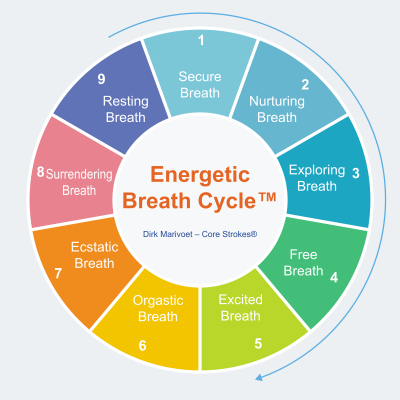
The Energetic Breath Cycle™ describes nine phases through which breathing organizes emotional experience, regulation, and relational contact.
At a developmental level, they resonate with the core symbolic needs identified by Al Pesso: the need for Place (to exist and take one’s place in the world), Nurturance (to receive nourishment), Support (to be accompanied and resourced), Protection (to feel safe from harm), and Loving Limits (to experience containment and structure that foster trust and autonomy).
Character patterns also leave imprints in the breath cycle. Drawing from Reichian character theory, enriched with contemporary understanding, we can see how specific breath phases correlate with adaptive patterns that arose from developmental wounds. In Core Strokes®, we use descriptive, compassionate terms such as fragmented, collapsed, inflated, conflicted, and overcontrolled to describe these patterns.
For example, when Secure Breath is disrupted, we often see adaptations of fragmentation—difficulty grounding, hypervigilance, and disembodiment. When Nurturing Breath is blocked, oral dynamics arise—longing, collapse, or relational over-adaptation. Exploring and Free Breath disruptions manifest as defended autonomy, blocked agency, or difficulty sustaining relational flow. Excited Breath may carry shame or inhibition around vitality and polarity. And Orgastic, Ecstatic, and Surrendering Breath phases often reflect the impacts of deep relational or spiritual wounds—limiting surrender, unity, and trust in life.
Breath rhythms themselves are diagnostic. The depth, tempo, ease, or constriction of breathing patterns reveal where the cycle is fluid or blocked.
Over time, the body’s connective tissue matrix adapts to life experience, storing impressions of safety, flow, rupture, or defense. In Neurofascial Encoding™, these stored qualities are felt as distinct fascial textures—each correlating closely with phases of the breath cycle. When the breath cycle is fluid and integrated, the fascia often presents as pliable, resilient, and subtly vibrant—qualities I describe through the metaphor of “streaming silk,” commonly observed in Secure Breath. In contrast, when phases have been shaped by trauma or chronic defense, the fascia may present with denser, more resistant qualities. Textures such as “gritty,” “cold wax,” or “mud” reflect varying degrees of disruption—where pulsation is incomplete, charge is trapped, or flow has been interrupted. These tactile and energetic qualities in the fascia serve as a living record of the breath-energy continuum—and provide precise somatic cues for guiding therapeutic work.
Each phase also aligns with autonomic profiles informed by Polyvagal Theory. Secure Breath supports ventral vagal safety; Exploring and Excited Breath engage healthy mobilization; Surrendering Breath moves toward safe immobilization. Dysregulation at any phase is both diagnostically rich and therapeutically addressable.
Relational dynamics are deeply shaped by breath phase integration. Early attachment ruptures leave imprints in Secure and Nurturing Breath, while later relational wounds affect Free, Excited, and Ecstatic phases.
Finally, as the breath cycle matures, it opens spiritual potentials: authentic self-expression, erotic vitality, transpersonal connection, surrender to life, and restoration of deep being.
In this way, the Energetic Breath Cycle™ becomes an unparalleled integrative map—not only for trauma resolution and therapeutic transformation, but for personal evolution and embodied spiritual practice.
Trauma and the Cycle: How It Is Encoded
When trauma disrupts the Energetic Breath Cycle™, it does so not only in where phases are blocked, but in how the body, breath, fascia, and relational field encode the disruption.
An interrupted phase leaves multi-level traces. Fascial densification holds uncompleted pulsation in the tissue matrix. Breath becomes constricted or fragmented—unable to complete natural cycles of charge and discharge. Autonomic tone locks into sympathetic or parasympathetic dominance, leaving hyper- or hypo-aroused states. The relational field is shaped by defensive adaptations—patterns of trust, boundaries, and contact all become distorted.
An essential insight here comes from the concept of counterpulsation—used by pioneers such as Charles Kelley, Will Davis, and further developed by Jack Painter. In trauma, the natural oscillation between activation and deactivation becomes frozen. Charge cannot complete; surrender cannot happen in safety. The system oscillates in stuck patterns—between chronic activation and defensive withdrawal.
Through micro-tracking—moment-to-moment somatic tracking—we can observe precisely where and how these oscillations are disrupted. The therapist’s task is to restore the capacity for safe, rhythmic pulsation—breath by breath, layer by layer.
Here, the contributions of Al Pesso offer profound depth. His concept of Shape and Countershape shows how trauma survivors unconsciously hold defensive shapes—bodymind forms that once adapted to overwhelming experience. In many cases of abuse or relational trauma, these shapes reflect pierced ego boundaries, leaving lasting imprints of intrusion.
Ego wrapping, another key insight from Pesso, teaches that therapy must first restore a protective container around the ego. Without this, the person cannot safely differentiate and integrate layers of memory and sensation. Pesso’s method of creating new symbolic memories aligns beautifully with Neurofascial Transformation Process™. As the breath cycle is restored, fascial patterns soften, autonomic regulation returns, and the body can encode new embodied memories of safety, connection, and vitality.
Bessel van der Kolk, a pioneer of modern trauma therapy and trained PBSP therapist, has shown how this synthesis of somatic, symbolic, and relational repair lies at the cutting edge of trauma resolution.
In the Breath Cycle, phase-specific trauma patterns become clear. Attachment ruptures are encoded earliest, in Secure and Nurturing Breath—compromising place, safety, boundaries, and the right to receive. Relational and developmental traumas disrupt Exploring, Free, and Excited Breath—punishing autonomy, shaming expression, and blocking vitality. Existential and transpersonal wounds distort Ecstatic, Surrendering, and Resting Breath—undermining surrender, unity, and trust in life.
Through this precise mapping, practitioners can track where the cycle is stuck, how defenses are organized, and tailor interventions to restore natural pulsation. By weaving together the legacies of Reich, Painter, Pesso, Polyvagal Theory, fascia science, and the living intelligence of the body, we can guide true resolution—not only of trauma, but of the deep imprints that shape identity and embodiment.
The Spiral Nature of the Cycle: Regression, Progression, Transformation
The Energetic Breath Cycle™ is not a mechanical sequence. It is a living spiral—responsive, recursive, and deeply adaptive to the evolving needs of the bodymind.
Jack Painter saw this intuitively. The cycle does not progress in a linear fashion. It spirals. Phases repeat, deepen, regress when needed, reorganize, and transform across time and development.
This understanding is now confirmed by Polyvagal Theory, trauma neuroscience, and Neurofascial Encoding™. Healing unfolds rhythmically, not as a linear ascent but through oscillations—between activation and settling, between charge and regulation, between contact and self-containment.
In Neurofascial Transformation Process™ , this spiral intelligence is observable in every session. Fascial tissues soften, resist, and soften more deeply. Breath cycles fragment, then gradually restore coherence. Autonomic dynamics oscillate toward greater flexibility. The relational field builds trust, meets defenses, renegotiates boundaries, and deepens presence.
This spiral is not random—it is developmentally intelligent. When early phases such as Secure and Nurturing Breath are incomplete, the spiral returns there first to repair foundational imprints. Here, Pesso’s Shape/Countershape and ego wrapping are essential. Without establishing containment, later expansion is not possible.
Trauma affecting later phases, such as Exploring, Free, or Excited Breath, requires the spiral to revisit those territories, restoring autonomy, expression, and the capacity for polarity.
Regression within the spiral is not pathological—it is healing wisdom. The bodymind returns to earlier phases to reclaim unmet needs and repair incomplete pulsations. Painter’s concept of pendulation, Pesso’s methods of new memory creation, and Polyvagal-informed scaffolding all support this process.
Progression is likewise not forced. When readiness emerges, the system naturally unfolds toward deeper charge, greater surrender, and fuller states of integration.
Through precise somatic tracking—breath, fascia, autonomic state, character tone, relational field—the practitioner can read where the spiral is cycling and co-create the conditions for the next natural phase transition.
As the spiral deepens, fascial textures evolve—from gritty to silken to streaming vitality. Structured water within the fascia reorganizes, enhancing tissue hydration, conductivity, and resilience. Breath rhythms restore coherence. Autonomic regulation stabilizes around ventral vagal tone. Relational presence deepens. And spiritual potentials begin to unfold.
Thus, the Energetic Breath Cycle™ serves not only as a therapeutic map, but as an ongoing pathway of personal, relational, and spiritual evolution—a spiral of embodied transformation.
Therapeutic Applications of the Energetic Breath Cycle
In both clinical practice and personal growth work, the Energetic Breath Cycle™ offers an exceptionally precise and dynamic map for diagnosis and transformation. By attuning to the client’s breath, movement, fascia, and relational field, practitioners can track exactly where the system is cycling—and where it may be stuck, fragmented, or compensating.
A Dynamic Somatic Assessment
At any moment in a session, it is possible to read the phase signature through multiple channels.
Breath reveals itself in volume, rhythm, oscillation, phase bias (inhalation or exhalation dominant), interruptions, and patterns of stasis.
Fascial texture, as mapped in Neurofascial Encoding™ , shows the imprint of trauma, resilience, or developmental history in the body’s connective tissue. These textures—such as streaming silk, warm honey, mud, grit, sandpaper, or cold wax—are palpable qualities in the fascia that reflect how breath, energy, and emotion have been shaped over time. They offer the therapist precise somatic clues to where the cycle is fluid, where it is held, and how to guide the restoration of natural pulsation.
- Autonomic state can be observed through shifts in ventral vagal tone, sympathetic activation, or dorsal collapse—each linked to specific breath phases and relational dynamics.
- Character tone is expressed through posture, movement, energetic field, and relational style. Here, Reichian and Core Energetics mapping offers rich guidance.
- Relational dynamics—patterns of hyper-independence, collapse, dissociation, fight/flight, or merging—further illuminate how phases are held or defended.
- Developmental needs, drawing from Pesso’s five core needs—Place, Nurturance, Support, Protection, and Loving Limits—can be correlated with specific breath phases and corresponding developmental stages.
Reading Phase and Need
Consider a few examples. A collapsed Secure Breath often reflects early attachment trauma—unmet needs for place and protection, pre-verbal fragmentation, or schizoid tendencies. An inhibited Nurturing Breath signals oral dynamics—longing for nurturance, fear of receiving, or relational collapse.
Constriction in Exploring Breath points to blocked autonomy and curiosity—often linked to psychopathic defenses, ambivalent attachment, or collapsed rigid structures. Interruptions in Excited Breathfrequently reveal polarity wounds—shame, premature sexualization, betrayal, or a history of unsafe vitality.
Distortions in Ecstatic, Surrendering, and Resting Breath often reflect transpersonal wounds—spiritual bypass, unresolved existential grief, fragmentation at the threshold of unity and identity.
Trauma Mapping: Beyond “Where” to “How”
As emphasized earlier, trauma is encoded not merely in which phase is blocked, but in how the system failed to complete pulsation. Incomplete oscillation leaves fragmented fascia, disordered breath rhythms, and autonomic freeze loops.
Here, counterpulsation and micro-tracking allow the therapist to observe exactly where the system oscillates between activation and avoidance—and where unresolved “unfinished business” prevents full integration.
Pesso’s Shape and Countershape principle is vital in this work. The practitioner must offer countershapes—somatic, relational, and energetic—that provide containment, ego wrapping, and safe conditions for the completion of each phase. Without this scaffolding, defenses will simply recycle.
New memory creation, central to Pesso’s approach, dovetails perfectly with the Breath Cycle. Each phase offers re-encoding opportunities: Secure Breath restores bodily memory of place and safety; Nurturing Breath supports memories of nourishment; Exploring Breath restores autonomous movement; Free Breath rebuilds coherent oscillation; Excited and Orgastic Breath encode safe charge and pleasure; Ecstatic, Surrendering, and Resting Breath open embodied trust in life’s flow.
Guiding the Cycle: Touch, Breath, Presence
Using Core Strokes®, Neurofascial Transformation Process™ , and bodymind integration skills, the therapist works to restore structural coherence—releasing fascial densification, rehydrating tissue (guided by insights from Pollack’s structured water research), and normalizing the breath wave.
At the same time, the therapist supports autonomic flexibility—engaging ventral vagal tone and guiding the client’s nervous system in safe oscillation.
Character integration is also a central focus—recognizing and compassionately working with Mask, Lower Self, and Higher Self dynamics, following Core Energetics principles.
Developmental ruptures are addressed through somatic and relational repair—providing missing experiences linked to Pesso’s five needs, through presence, touch, and attuned interaction.
Throughout the process, the therapist tracks phase transitions and spiral dynamics—supporting safe regression when needed and guiding progression only when readiness is embodied.
The Goal: Restoring Natural Pulsation
Ultimately, therapeutic work with the Energetic Breath Cycle™ seeks to:
- Restore natural, unforced pulsation across all phases;
- Re-integrate autonomic, fascial, breath, character, and relational coherence;
- Re-pattern embodied memory—from fragmented survival strategies to integrated wholeness;
- Deepen capacity for presence, intimacy, pleasure, creativity, and spiritual connection;
- Support a life lived in dynamic contact—with self, others, and the greater field of life.
Beyond Therapy — A Path of Personal and Spiritual Evolution
The Energetic Breath Cycle™ is far more than a clinical tool. It is a living map of human potential—a gateway to personal unfolding and embodied spiritual integration.
At its core lies a profound truth: our breath is not merely physiological—it is existential. Each breath carries the imprint of our developmental history, our trauma, our character strategies, our capacity for pleasure and presence, our longing for contact, and our relationship with the greater field of life.
Jack Painter saw this deeply. Through the breath cycle, clients would open not only to trauma resolution, but to polarity integration, orgastic potency, spiritual surrender, and ultimately to transpersonal states of connection and flow.
Today, with the integration of Polyvagal Theory, fascia research, attachment-informed presence, Core Energetics consciousness mapping, Pesso’s Shape/Countershape principles, McIntyre-Mullins reservoir insights, and Pollack’s structured water discoveries, we can see even more clearly: the breath cycle is a spiral path of embodiment.
It is a journey of progressive integration—moving from fragmented survival strategies toward coherent, fluid being. It allows us to re-encode our relationship to existence itself—not merely to heal the past, but to open the bodymind to deeper layers of creative potential, relational depth, and spiritual embodiment.
Breath, Fascia, and Consciousness
Pioneers such as James Oschman and others in biological energetics propose that fascia functions as a semi-conductive, liquid crystalline network—capable of transmitting electromagnetic, mechanical, and informational signals throughout the body.
Research by Gerald Pollack on structured water enriches this view, suggesting that the interfacial water within fascia and cellular matrices plays a key role in bioelectric coherence and energy storage.
In this perspective, breath, movement, and subtle touch do not merely mobilize tissue mechanically—they modulate the biofield and informational state of the fascial system. As breath restores its natural spiral, as fascial texture reorganizes toward silken coherence, and as autonomic tone stabilizes around ventral vagal safety, the entire system opens to higher states of integration and coherence.
Clients often report experiences of expanded awareness, synchronicity, heightened intuition, timelessness, and deep unity with the body and with life itself.
The Spiral as a Spiritual Path
In this sense, the upper phases of the cycle—Ecstatic Breath, Surrendering Breath, and Resting Breath—are not simply post-therapy states. They are gateways to spiritual integration, transpersonal contact,and embodied presence that transcends ego.
Crucially, these states are not achieved by bypassing the body. They emerge through embodied safety—by repairing the early phases, reclaiming lost breath, restoring full pulsation, and reorganizing fascial, autonomic, relational, and spiritual coherence.
A Path for Practitioners and Clients Alike
The Energetic Breath Cycle™ serves both as a map for clinical healing—trauma resolution, character integration, relational repair—and as a path for personal evolution—greater authenticity, love, creativity, and embodied joy.
For many, it becomes a spiritual path—one that unfolds not in the abstraction of mind, but through the living intelligence of the body.
As practitioners, we do not guide this cycle only for our clients. We walk this spiral ourselves—breath by breath, moment by moment.
Painter knew this.
Pesso embodied this.
In honoring their lineage, we carry forward a path where therapy becomes practice, practice becomes life, life becomes breath, and breath becomes Being.
Closing — A Living Spiral of Embodied Evolution
The Energetic Breath Cycle™ is not a fixed technique, nor a linear protocol. It is a living spiral—a map that evolves with each breath, each moment of presence. It honors the deep lineage of this work:
- Wilhelm Reich, who first revealed the pulsation of life.
- Jack Painter, who mapped the breath cycle as an embodied spiral of healing and awakening.
- Al Pesso, who taught us to restore the inner architecture of the self through embodied experience.
- And the many voices of contemporary science—Polyvagal Theory, fascia research, attachment theory, consciousness studies—that continue to deepen this understanding.
In my work with Core Strokes®, Neurofascial Encoding™ , and the Neurofascial Transformation Process™ , this cycle serves both as a diagnostic map—to track where the bodymind is open or defended—and as a path of transformation—to restore pulsation, deepen embodied safety, and open new potentials for love, presence, and creative being.
For some, this process is deep trauma healing. For others, a journey of personal growth. For many, it becomes a spiritual path—one that begins with the breath and unfolds through embodied experience. And always, it begins here:
With the breath.
Every cycle is new.
Every breath is a return—and an invitation to evolve.
The Energetic Breath Cycle™ is a map.
You are the territory.
In breath, in body, in life—may the spiral unfold.
HONORING, EVOLVING, AND DEEPENING THE WORK OF JACK W. PAINTER, PHD
Honoring Jack’s Legacy
For over twenty-five years, I had the privilege of working closely with Jack W. Painter, PhD (1933–2010)—teaching, researching, and practicing alongside him. His groundbreaking methods of Postural Integration®, Energetic Integration®, and Pelvic-Heart Integration® remain pillars in the field of bodymind integration.
After earning his PhD from the University of Atlanta and completing post-doctoral research in Europe, Jack became a Professor of Natural Philosophy at the University of Miami. During this time, he immersed himself in the Human Potential Movement—not merely as an academic observer, but out of a profound personal quest for healing and transformation.
Driven by a deep inquiry into how body, mind, and consciousness interrelate, Jack trained in massage therapy at the Lindsay-Hopkins Institute in Miami, grounding his work in direct, hands-on therapeutic practice. This synthesis of philosophical inquiry, embodied experience, and clinical skill became the seedbed of his life’s contribution.
Among Jack’s most significant contributions was the Natural Cycle of Energy (NEC)—a dynamic model describing how life energy flows through the bodymind. He understood this cycle not as a fixed sequence, but as a living spiral: adaptive, rhythmic, and inherently human.
In his later work, Jack described this energetic process in increasingly differentiated ways, referring to phases of expansion, surrender, and relaxation within the organism’s natural pulsation.
The Energetic Breath Cycle™, developed by Dirk Marivoet, builds directly on this foundation. It further articulates and differentiates this pulsatory process into a structured nine-phase spiral, introducing refined distinctions such as Ecstatic Breath, Surrendering Breath, and Resting Breath.
While rooted in Painter’s Natural Cycle of Energy, the specific phase structure and terminology of the Energetic Breath Cycle™ are a later development within the Core Strokes® framework.
Jack’s original model was both character-based and implicitly fascia-informed, integrating Reichian insights on armoring and character structure with principles from Structural Integration (Rolfing). His work was enriched by breathwork, Gestalt therapy, energetic touch, and pioneering insights into pulsation, counterpulsation, and transpersonal dimensions of healing.
Far ahead of his time, Jack recognized that the breath-energy process unfolds as a spiral—non-linear, adaptive, and responsive to both developmental history and present relational conditions. He emphasized that relational safety is fundamental, and that early relational ruptures must be addressed through embodied and relational presence before deeper energetic integration can occur.
His legacy also includes important contributions to the international somatics community. He organized visionary events such as the 1995 San Francisco Somatics Congress, bringing together pioneers including Stanley Keleman, John Pierrakos, Peter Levine, Stanislav Grof, Emilie Conrad, Anna Halprin, Robert Schleip, and many others. (Gerda Boyesen, who had been invited, was unable to attend due to illness.) I was present at this landmark event as a participant—an experience that profoundly shaped my own path in the field.
It is with deep respect for Jack’s vision and contribution that I offer this further development of his work—an evolution that integrates contemporary insights while remaining grounded in the original pulsatory principles he articulated.
Why Evolve the Cycle?
Since Jack’s time, multiple scientific and clinical fields have developed significantly, allowing for a more precise and integrative understanding of the breath-energy continuum.
Stephen Porges’ Polyvagal Theory has illuminated how the nervous system continuously regulates states of safety and threat, shaping breath, physiology, and relational engagement.
Contemporary fascia research, led by figures such as Robert Schleip, Carla Stecco, Jaap van der Wal, and Helene Langevin, has revealed fascia as a dynamic, living matrix—capable of holding emotional and energetic patterns that directly influence breath and embodiment.
Attachment theory, through the work of John Bowlby, Mary Ainsworth, Peter Fonagy, Allan Schore, and Dan Siegel, offers a refined understanding of how early relational experience shapes self-regulation, breath, and embodied presence.
Core Energetics and the Pathwork teachings of John Pierrakos and Eva Pierrakos deepen insight into the dynamics of Mask, Lower Self, and Higher Self within the flow of life energy.
The McIntyre-Mullins Reservoir Model further clarifies how energetic charge is distributed and regulated across the head, torso, and pelvis.
Neurofascial Encoding™, my own contribution, integrates these domains into a unified framework, showing how experience becomes encoded in breath, tissue, and relational field—and how these patterns can be transformed through precise somatic and relational work.
Advances in affective and developmental neuroscience, including the work of Antonio Damasio, Ruth Lanius, and Jaak Panksepp, further illuminate how embodied consciousness and emotional regulation emerge—and how they fragment under conditions of trauma.
Finally, the work of Al Pesso has been deeply influential in shaping my understanding of relational dynamics through concepts such as Shape, Countershape, and symbolic completion.
In evolving the Energetic Breath Cycle™, my intention is not to replace Jack’s model, but to honor and extend it—integrating contemporary knowledge to create a more precise, relationally attuned, and clinically effective framework.
What emerges is a model that allows us to track how trauma and defense patterns shape the breath-energy continuum, how natural pulsation can be restored, and how healing can unfold across somatic, emotional, relational, and transpersonal dimensions.