

By Dirk Marivoet, MSc
Founder of Core Strokes® & The Neurofascial Transformation Process™
International Institute for Bodymind Integration
Introduction — Beyond Regulation
Somatic psychotherapy—also known as body psychotherapy or body-oriented psychotherapy—is a form of psychotherapy that focuses on how experience is lived, organized, and expressed in the body. In recent decades, somatic psychotherapy has become widely recognized for its effectiveness in working with trauma, stress, and nervous system dysregulation.
To understand how these patterns become organized in the body, see Somatic Trauma – Understanding How Trauma Lives in the Body.
Much of this work focuses on regulation—supporting the organism in moving out of overwhelm, collapse, or chronic activation, and restoring a basic sense of safety in the body.
This is an essential foundation.
Without sufficient regulation, deeper therapeutic work is not possible.
Yet clinical experience shows that regulation, while necessary, is not the endpoint of the therapeutic process.
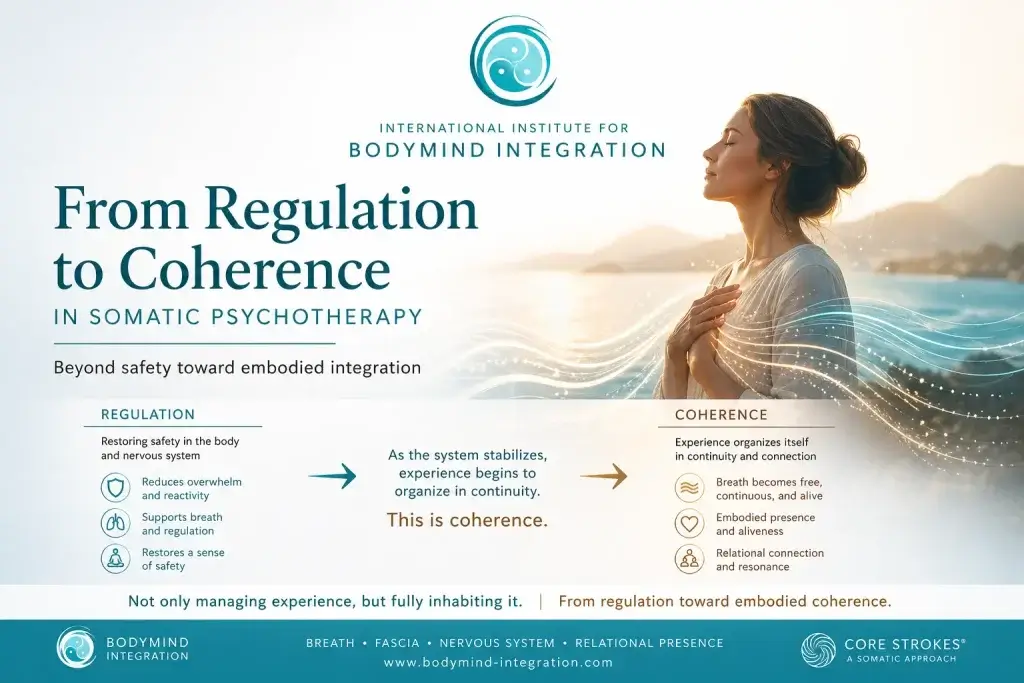
As the system stabilizes, another layer of experience begins to emerge—one that is less about managing intensity, and more about how experience organizes itself from within. This shift can be understood as part of a broader movement from regulation toward integration within the field of somatic psychotherapy.
This movement gradually unfolds from regulation toward embodied coherence—a state in which breath, body, and relational presence begin to align into a more integrated whole.
The Limits of Regulation Alone
In many therapeutic processes, a client may reach a point where:
- the nervous system is more stable
- emotional overwhelm has decreased
- bodily awareness has increased
And yet, something remains incomplete.
Clients may say:
- “I feel better, but not fully myself.”
- “I can regulate, but I don’t feel deeply alive.”
- “Something is still missing.”
This experience is often seen in people working with chronic stress in hte body or persistent anxiety patterns.
This reflects an important distinction:
stabilization is not the same as integration
Regulation reduces dysregulation.
But it does not necessarily reorganize how experience is lived.
The Emergence of Coherence
As defensive patterns soften and the organism no longer needs to organize primarily around protection, a different quality begins to appear.
Experience becomes more coherent. In the Core Strokes® framework, this process is further explored through models such as the Energetic Breath Cycle™and the Fascia Texture Typology™.

This is not something that is produced or imposed.
It becomes perceptible as interference in the system decreases.
Rather than fragmenting or compensating, the organism begins to organize in continuity.
What Coherence Feels Like in the Body
This shift toward embodied coherence is often subtle, yet clearly recognizable.
It may be experienced as:
- breath becoming more continuous and effortless
- a sense of inner continuity rather than fragmentation
- the body feeling more unified and inhabitable
- posture organizing itself without conscious control
- presence becoming more stable and less effortful
Experience is no longer primarily shaped by defensive patterns.
It begins to organize itself.
The body is no longer something to manage—it becomes a place one can inhabit. This quality of inhabiting the body is closely related to what is described as Soul Resonance—the felt sense of coherence in the living body.
From Managing Experience to Inhabiting It
In earlier phases of therapy, much of the work involves:
- reducing overwhelm
- increasing tolerance for sensation
- restoring basic regulation
These are essential capacities.
But as they stabilize, the orientation of therapy shifts.
The question is no longer only:
👉 “Can I handle this experience?”
But increasingly:
👉 “Can I fully inhabit it?”
This marks a developmental movement:
- from regulation → toward coherence
- from control → toward participation
- from adaptation → toward expression
Coherence as an Embodied Process
Coherence is not a technique or an externally imposed goal.
It is an emergent property of the living system.
When breath, fascia, and nervous system dynamics begin to organize in continuity, experience can flow rather than fragment.
In this state:
- sensation, emotion, and awareness align
- movement becomes more fluid and responsive
- relational contact deepens without effort
- the organism expresses itself more directly
The body begins to function as a coherent field of experience.
The Relational Dimension of Coherence
This shift does not occur in isolation.
It is deeply supported within relational presence.
Through attuned contact—whether through touch, voice, or shared attention—the organism can reorganize beyond habitual defensive patterns.
As coherence stabilizes:
- contact becomes more direct and less mediated by defense
- relational presence deepens
- a shared sense of aliveness or stillness may emerge
Coherence is therefore not only an individual state.
It is also a relational phenomenon. This is why relational presence plays a central role in somatic psychotherapy.
Beyond Trauma Work
Somatic psychotherapy is widely known for its role in trauma therapy.
But its scope is broader.
It does not only address dysregulation.
It also supports the emergence of:
- embodied presence
- relational openness
- emotional depth without overwhelm
- a sense of inner orientation and meaning
These processes can be observed across a range of lived experiences, including depression, trauma, and relational difficulties.
In this sense, therapy moves from resolving what is disrupted toward supporting what can emerge
A Bridge Toward Embodied Integration
Within the broader field of somatic psychotherapy, different approaches articulate this shift in different ways.
In the Core Strokes® framework, this transition is described through models of embodied coherence.
These include:
- Soul Resonance — the felt experience of coherence in the living body
- Soul Textures™ — differentiated qualities of embodied integration
- The Energetic Breath Cycle™ — phases through which experience organizes and unfolds
- The Neurofascial Transformation Process™ — how patterns reorganize through somatic and relational work
These models offer a language for recognizing how integration becomes visible in breath, fascia, and relational presence.
→ Explore these concepts in more detail:
Within the broader field of somatic psychotherapy, these models describe how integration becomes visible in the body.
Conclusion — The Next Step in Somatic Psychotherapy
Somatic psychotherapy begins with regulation. But it does not end there.
For a broader overview of the field, see Somatic Psychotherapy – Working with Body, Breath and Trauma.
As the organism stabilizes, a deeper process becomes possible—one in which experience is no longer only managed, but reorganized into coherence. This reorganization builds on the foundational processes described in Somatic Trauma – Understanding How Trauma Lives in the Body.
In this process, the body is not simply regulated.
It becomes inhabited.
And within that inhabitation, something fundamental begins to emerge:
- a sense of continuity
- a sense of aliveness
- a sense of meaning
Not as an idea—
but as a lived, embodied reality.
→ Recommende Resources for Somatic Psychotherapy & Bodymind Integration